


Let’s be honest, talking poop isn’t exactly anyone’s cup of tea but as soon as you become a parent, it’s suddenly getting a pretty regular mention because it can tell us quite a bit about our baby’s health.
So what’s normal?
‘Normal’ can vary from one child to the next. A ‘normal’ stool can vary in terms of colour, smell, consistency and frequency. Factors like your child’s age, whether or not they are breastfed or formula fed and any solids they are consuming, can directly impact your little one’s stools. While there can be significant variations from one poop to the next, there are some general features that will help you decode what your child’s poop means.
Newborn Poop
Newborn poop, also known as meconium is quite different from the poop that will become their ‘norm’ after a few days. Meconium is a greenish-black, tarry substance that is made up of mucus, amniotic fluid, and other things your baby ingested in utero. It is typically odourless. Newborn babies will usually pass their first meconium stool within 24 hours of birth and ideally by the time they are 48 hours old. After the meconium passes, their poop will gradually become lighter in color and consistency.
Colour
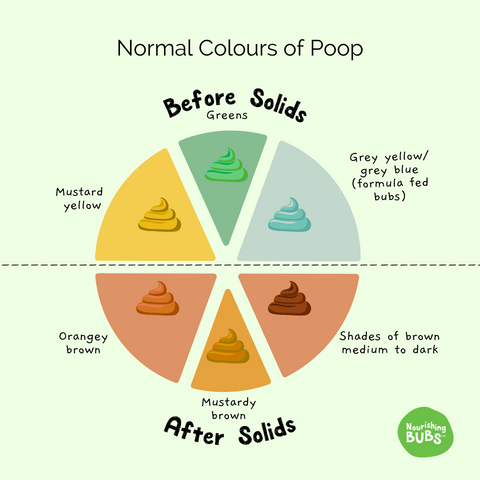
Normal baby poop can range in color from yellow to brown to green. Breastfed babies usually have pale yellow or mustard-coloured stools while a formula-fed bub usually has a more brown-green coloured stool.
- Mustard yellow: This is the most common color of baby poop, and it is usually a sign of a healthy baby. In breastfed babies, it is often described as yellow and seedy.
- Green: Green poop can be caused by a number of things, including eating green vegetables, or taking certain medications. It is also often due to rapid transit time through the digestive system. It is usually not a cause for concern, but if it persists, it is best to check with your doctor.
- Orange: Orange poop can be caused by eating foods that are high in beta-carotene, such as carrots, sweet potatoes, and cantaloupe. It is also sometimes caused by food allergies or intolerances.
- Red: Red poop can be a sign of blood in the stool. This can be caused by a number of things, including constipation, anal fissures, or infections. It is important to see a doctor right away if you notice red poop in your baby’s nappy. It can however also be due to consumption of very red foods such as beetroot, which is not a cause for concern.
- Black: Black poop can be caused by bleeding in the upper gastrointestinal tract, such as the stomach or esophagus. It can also be caused by taking iron supplements. Particularly if your little one is on an iron supplement, black poop is not usually a cause for concern, however it is important to see a doctor if it persists or you are at all worried.
- Light/White/Clay: White or pale poop can be a sign of liver disease or a blockage in the bile duct. It is important to see a doctor right away if you notice white or pale poop in your baby's nappy.
Smell
Like the colour of poop, the smell of baby poop can vary significantly. Prior to starting solids though, the smell of baby’s poop is usually quite sweet and largely unoffensive (breastfed baby’s poop is often a little sweeter when compared to formula-fed bubs). There are however a few things which can cause a young baby’s poop to be more odourous, like infections (eg. gastro), medications, food allergies, diarrhoea or constipation.
Once they commence solid foods, the foods they consume will impact the smell of their stool and it usually becomes more adult-like and a little more ….well yuck!
Consistency
Newborn babies typically have runny or watery poop. As they get older, their poop will become thicker and more paste-like.
Breastfed babies typically have looser poop than formula-fed babies. This is because breast milk is easier to digest than formula. Formula-fed babies typically have thicker, pastier poop that is similar to peanut butter in consistency.
By the time babies are 4-6 weeks old, their poop will usually have a regular consistency. However, it is important to note that the consistency of baby poop can vary from day to day.
Here are some things to watch for in baby poop consistency:
- Hard, pebble-like poop → sign of constipation
- Runny or watery poop → sign of diarrhea
- Mucous or blood in the poop → sign of an infection or other medical condition.
Frequency
The frequency with which your baby poops can also vary greatly depending on age, diet and any medical conditions however generally most babies will poop 2-5 times per day.
Newborn babies may poop up to 10 times per day in the first few weeks of life. As babies get older, their digestive system matures and they are able to digest milk more efficiently. This is why older babies typically poop less often. By the time babies are 4-6 weeks old, they will usually poop 2-5 times per day.
Some babies may poop more often or less often than others. This is perfectly normal, as long as your baby is pooping regularly and their poop is soft and easy to pass.
Here are some things to watch for in baby poop frequency:
- Pooping less than once every 2-3 days may indicate constipation
- Pooping more than 5 times per day may indicate diarrhea
If your baby suddenly starts pooping more often or less often than usual, this could be a sign of something else going on.
What’s Not Normal
As touched on above, there are a few things that are NOT normal when it comes to baby poop.
Constipation
While not normal, constipation in babies is a common problem. Poops will often appear hard, dry and pebble-like and can even result in blood in the stool. It often results in discomfort and difficulty passing poops and your little one may appear to strain and grunt when pooping. Due to the discomfort, it will also often result in infrequent bowel movements.
If your baby is showing signs of constipation, make sure they are well-hydrated by checking that their urine is pale yellow, as opposed to dark yellow. Diet also plays a role, especially diets that are low in fibre or diets that change rapidly to being very high in fibre, such as when starting solids. Gradually increasing your baby's intake of high-sorbitol foods, such as prunes, apples, pears, kiwi, and stone fruits like peaches, plums, and nectarines, can often provide natural relief. However if symptoms persist for more than a few weeks, make an appointment with your GP or paediatrician.
Diarrhoea
Diarrhoea is another common, although ‘not normal’ occurrence in young children. It is characterised by three or more, loose, watery poops. While one or two loose stools is not cause for concern, the main risk associated with diarrhoea is dehydration. Signs your bub may be dehydrated are a sudden increase in the frequency of poops, very dark yellow urine, fewer wet nappies, odourous poop and/or blood or mucous in the stool. If you notice any of these symptoms or your bub has had diarrhoea for more than 24 hours or is less than one month old, your best course of action is to seek medical attention.
Black, Red or White Poop
It’s been previously mentioned that poop can vary in colour depending on age and diet. While black poop can be due to an iron supplement and red poop may be due to beetroot (or other red foods) at lunch, in the absence of these, black and red stools may be cause for concern. In addition, if you notice pale, white or chalky stools in your bub’s nappy, get in touch with your doctor immediately.
Remember the purpose of the information above is not to scare you but to equip you with the knowledge to know what is normal and not so normal … because this parenting gig can be testing at the best of times! And if you are ever in doubt or concerned, make an appointment to check in with your paediatrician or GP.
References:
Baby Constipation Symptoms (Hopkins Medicine) <https://www.hopkinsmedicine.org/health/conditions-and-diseases/constipation-in-children/baby-constipation-symptoms> (accessed on 25th October 2023)
Constipation, Royal Children’s Hospital Melbourne <https://www.rch.org.au/kidsinfo/fact_sheets/constipation/> (accessed on 25th November 2023)
Diarrhoea (0-12 Months), Seattle Children’s Hospital <https://www.seattlechildrens.org/conditions/a-z/diarrhea-0-12-months/ >(accessed on 25th November 2023)